
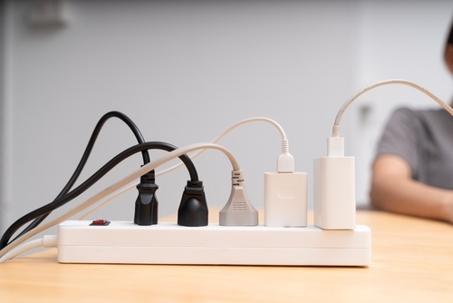
Walk through most homes in Colorado Springs and you'll see power strips plugged in under desks, behind entertainment centers, and on nightstands. Many homeowners assume those strips protect their electronics from power surges. Most of the time, they don't.
A power strip and a surge protector look almost the same. Both have multiple outlets and a single wall plug. The difference isn't visible from the outside. It's in how the device reacts when a voltage spike travels through your home's wiring.
To talk with our Colorado Springs electrical team at Awesome Home Services about whole-home surge protection, call (719) 800-7121 or send an online message.
What a Power Strip Actually Does
A standard power strip is simply an extension device. It connects to one wall outlet and multiplies the number of available outlets, providing more places to plug in devices. That's all it does. A power strip offers no protection against voltage spikes, surges, or fluctuations. It doesn't filter the power coming from your wall; it passes whatever the wall delivers directly to your devices.
Some power strips have a circuit breaker that trips when the total current drawn by connected devices exceeds the strip's rated amperage. This protects against overload (too many devices drawing too much current at once), but it does nothing for surges, which are voltage events, not current events.
If your power strip came in a pack of two for less than $15 and has no labeling about joule ratings, clamping voltage, or UL 1449 certification, it likely does not include surge protection.
What a True Surge Protector Does
A true surge protector features a component (most often a metal oxide varistor (MOV)) that absorbs excess voltage and redirects it away from your connected devices. When a voltage spike occurs from the grid, the MOV absorbs the extra energy and limits the voltage to a level your electronics can handle.
When you're shopping for a surge protector, look for:
- Joule rating – The total energy the protector absorbs before it can no longer function. Higher is better. For electronics like computers and televisions, look for 1,000 joules or more. For major appliances, 2,000 joules or higher is a reasonable target.
- Clamping voltage – The voltage level at which the surge protector activates. Lower is better. A clamping voltage of 400V or less is a reasonable standard.
- UL 1449 certification – This is the safety standard for surge protective devices in the United States. A device without this certification has not been independently listed for its surge protection claims.
- Protection indicator light – Many quality surge protectors include an indicator light that shows when the MOV has reached its capacity and the device is no longer providing protection. Once that light goes out, the protector needs to be replaced, even if the outlets still work.
Why True Surge Protection Matters in Colorado Springs
Colorado Springs sits in a region with frequent summer thunderstorms — lightning events that send surges through the utility grid and into homes throughout the area. Wind events that bring down power lines cause grid disruptions, producing surges when power is restored. And at Colorado's higher elevation, where electrical infrastructure spans more exposed terrain, the likelihood of surge events is higher than in many other regions.
A point-of-use surge protector at each sensitive device is a reasonable starting point, but it doesn't address surges that enter your home through appliance circuits, HVAC wiring, or other paths that bypass your electronics.
Whole-home surge protection, installed by a licensed electrician at the main panel, intercepts surges at the point of entry before they reach any circuit in the house.
At Awesome Home Services, our electricians install panel-level surge protection as a standalone service or as part of other electrical work. We explain the options, give you the installed cost up front, and make sure the protection is properly rated for your home's electrical capacity.
Contact us at (719) 800-7121 to schedule home surge protection installation in Colorado Springs. Our team is licensed, insured, and available 24/7 for electrical emergencies.
