
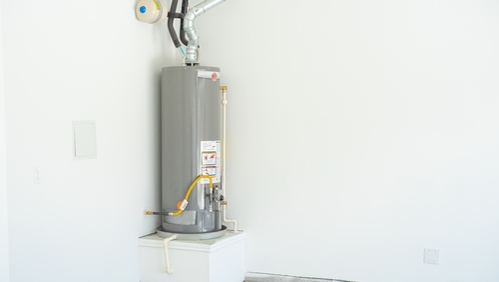
Estimated reading time: 6-7 minutes
If you've never drained your water heater, you're in the majority. Most homeowners don't know it's something they're supposed to do, and the ones who do often aren't sure how often or whether it's a DIY task. This covers all of that.
I'm Dean Christian, the Plumbing Manager at Awesome Home Services. Bob Vila's team quoted me on this topic recently, and the core message there applies here: sediment buildup is one of the most common causes of water heater failure, and annual maintenance prevents it. This blog covers why it happens, how to do the flush yourself, and when it makes more sense to call a plumber.
To schedule water heater service in Colorado Springs, call (719) 800-7121 or contact us online.
Why Does Sediment Collect in a Water Heater?
Every time your water heater fires, it heats water that carries dissolved minerals, primarily calcium and magnesium. As that water temperature rises and falls across thousands of cycles, those minerals separate out and settle to the bottom of the tank. The process is slow, but it never stops.
Colorado water runs hard. The snowmelt and groundwater that feed most of the state's supply carry higher mineral concentrations than softer-water regions, which means sediment accumulates faster here than manufacturer maintenance schedules account for.
The settled layer insulates the tank floor from the burner below it. Your water heater runs longer cycles to move the same amount of heat through that barrier into the water above. Utility costs go up gradually, and the tank's service life comes down.
How Do You Know Sediment Is Building Up?
The most common pattern before a drain call: the shower runs well for a few minutes and then it doesn't. The temperature drops before you touch the dial, and it happens consistently enough that you start to notice the pattern.
A few weeks later, you’re hearing popping or low rumbling from the tank while it's cycling; that's water pushing through a compressed mineral layer at the bottom. By the time the hot tap starts running orange or rusty, the tank has been signaling the problem for months.
Water pooling around the base of the tank is a different concern. At that point, the tank may have developed a leak at a fitting or at the drain valve, and the question shifts from maintenance to how much service life is left.
When Is the Right Time to Drain It?
You should drain it once a year. In Colorado Springs, where hard water accelerates buildup, that schedule accounts for the mineral load your tank is handling, not the load the manufacturer assumed when they wrote the maintenance guide.
Fall is the better window. Draining and inspecting the tank before the weather cools down means you're going into winter knowing the system is clean and running within spec. Late September or early October, before cold nights put a sustained load on the heater, is when I'd schedule it.
Should You Drain an Older Water Heater Yourself?
The point at which the risk equation changes is often when a water heater has moved beyond its warranty period. Depending on the manufacturer and model, that can be anywhere from six to twelve years. If a tank has never been flushed and is now past its warranty coverage, sediment is no longer loose debris. Over time, it compacts into a hardened layer at the bottom of the tank, changing how the system responds when the drain valve is opened.
In these conditions, opening the drain valve can create problems. The valve may not seal properly afterward because it was never designed to handle large amounts of hardened mineral buildup. In some cases, changes in pressure can disturb long-settled deposits, affecting seals that have remained stable for years.
What begins as routine maintenance can quickly become a repair project, involving a leaking drain valve or a tank that no longer operates as it did before being disturbed.
If you're unsure of the tank's age or service history, check the manufacturing date on the data plate—typically located on the upper portion of the unit—and determine whether it is still within its warranty period. A water heater that is beyond its warranty coverage and has no documented maintenance history warrants a professional assessment before opening the drain valve.
How Do You Drain a Water Heater?
The full process runs about an hour for draining and another 30 to 60 minutes for a gas water heater to reheat. Clear space around the drain valve for the hose before you start, and confirm you have somewhere to route the water: a floor drain, utility sink, or an outdoor exit works.
You'll need a standard garden hose, work gloves, and a flat-head screwdriver if your drain valve has a slot rather than a handle.
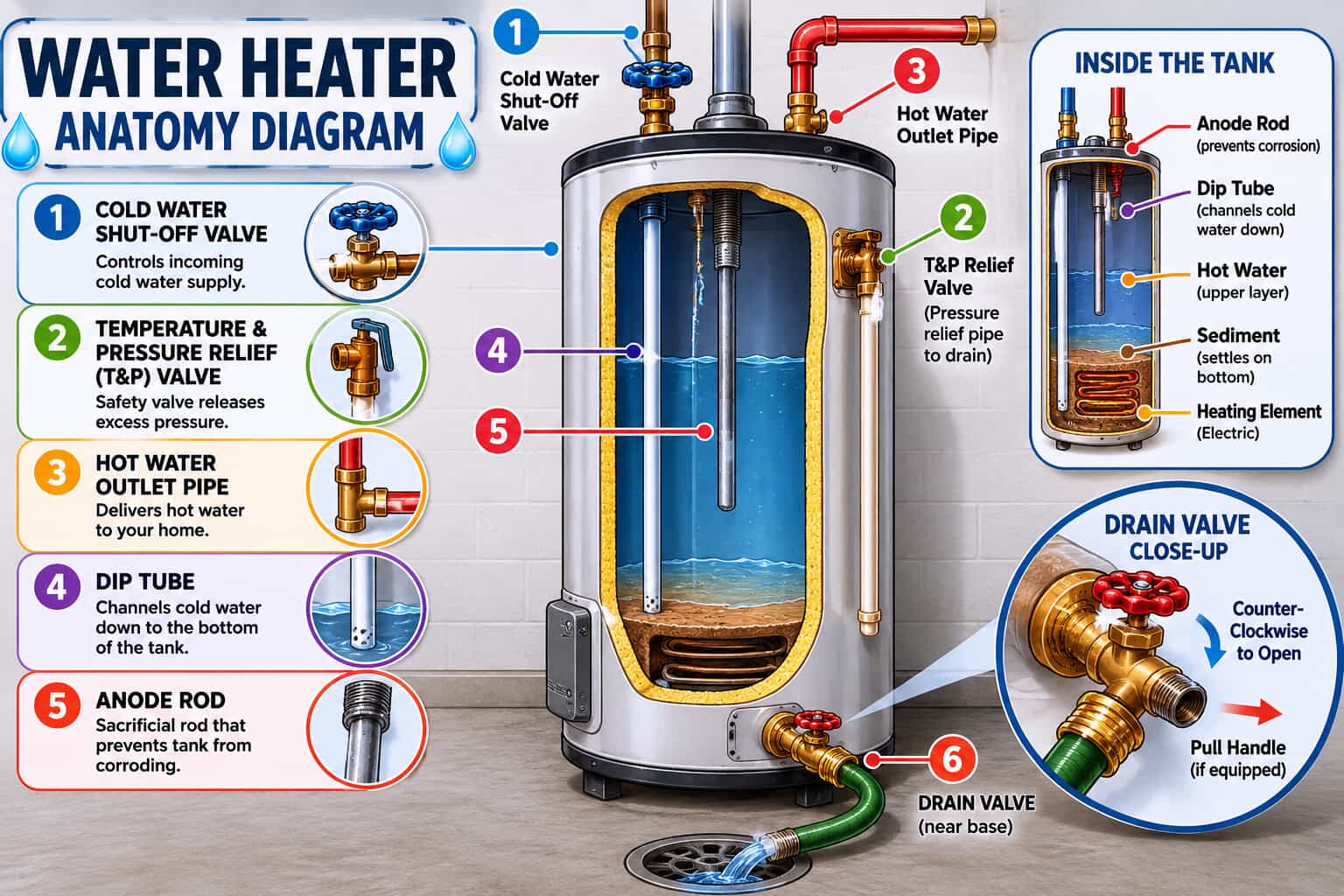
Step 1. Set the thermostat to the lowest setting or vacation mode. For a gas unit, turn the control knob to "Pilot." For electric, go to the breaker panel and switch the circuit off. The tank needs to cool before you drain it (water from an active water heater is hot enough to cause burns).
Step 2. Locate the cold water shut-off valve on the supply line feeding the top of the tank and close it. This stops new water from entering while the tank drains.
Step 3. Connect your garden hose to the drain valve near the base of the tank. Thread the fitting hand-tight and route the hose to your drain point.
Step 4. Open a hot water faucet somewhere in the house (any bathroom sink works). This relieves the vacuum inside the tank and lets water flow steadily through the drain hose rather than sputtering out in spurts.
Step 5. Open the drain valve. Use the screwdriver on the slot (counterclockwise) or pull the handle outward if it has one. Water will run discolored for the first several minutes as sediment clears. That's the point of the exercise.
Step 6. Once flow slows significantly, briefly open the cold water shut-off valve. That incoming flush stirs remaining sediment off the tank floor and carries it out through the hose. Close the shut-off again and let the tank drain fully.
Step 7. When the tank is empty and water has stopped flowing, close the drain valve firmly. Close the hot water faucet you opened. Then open the cold water shut-off valve to refill the tank.
Step 8. The tank is full when water flows steadily from the hot tap you left cracked. Close that tap. For gas, relight the pilot and set the thermostat back to 120 degrees. For electric, restore the breaker at the panel.
When Should You Call a Plumber Instead?
If the drain valve doesn't close cleanly after you've opened it, stop. A valve that drips or continues running after being closed needs to be replaced before the tank goes back into operation.
Rusty water that doesn't clear up after the initial drain — orange or reddish at the hose after ten or more minutes of flow — points to corrosion inside the tank, not loose sediment. At that point, the question is how much service life the tank has left, not whether a flush is enough.
For water heaters 12 to 15 years old, a professional maintenance visit covers more than the drain. Our technicians inspect the anode rod at the same time; that's the component protecting the tank lining from corrosion and the one that needs periodic replacement. Most manufacturer warranties also require documented annual service to stay valid. An inspection visit covers that requirement.
A water heater flushed annually runs more efficiently, lasts longer, and costs less to operate than one that doesn't. The process is straightforward on a tank that's been serviced before. If yours is older or has no service history, a call to a plumber is the better starting point.
Written by: Dean Christian, Plumbing Manager
 Dean Christian serves as the Plumbing Operations Manager at Awesome Home Services, bringing more than 12 years of hands-on residential plumbing experience to the team. Having worked across three different states, Dean brings a broad perspective and deep understanding of what it takes to deliver reliable, high-quality plumbing service in a wide range of homes and situations.
